InSmallGardens Instagram

Showing posts with label GreenTech Academy at Small Middle School. Show all posts

Tuesday, March 6, 2012

10th Annual Native Plant Sale


Come out and help us celebrate a decade of fundraising for the gardens at Clint Small Middle School.


We'll be featuring native trees, shrubs, grasses, perennials, and cacti most grown by students on campus in Margaret's House. We will have Green Academy t-shirts, too.

This year we will try something totally new. We will be selling during and after the school day on Wednesday, April 4th and Thursday, April 5th. We will start at 8:30 and operate continuously until 6:3o both days.

Our school is located at 4801 Monterey Oaks Blvd. The sale will be in and around Margaret's House which is located on the northwest part of the campus. Look for signs.


Margaret's House is dedicated to local naturalist, Margaret Bamberger, who shared her love and knowledge with dozens of classes from the Oak Hill area. Its mission is to study, propagate, and distribute plants native to this area.


Proceeds from the sale will benefit the native plant studies at Small Middle School. Cash or check only. Thank you.

Thursday, March 24, 2011

Nature Journaling: Honing Observation Skills


Observation is a vital skill that is useful in any profession.


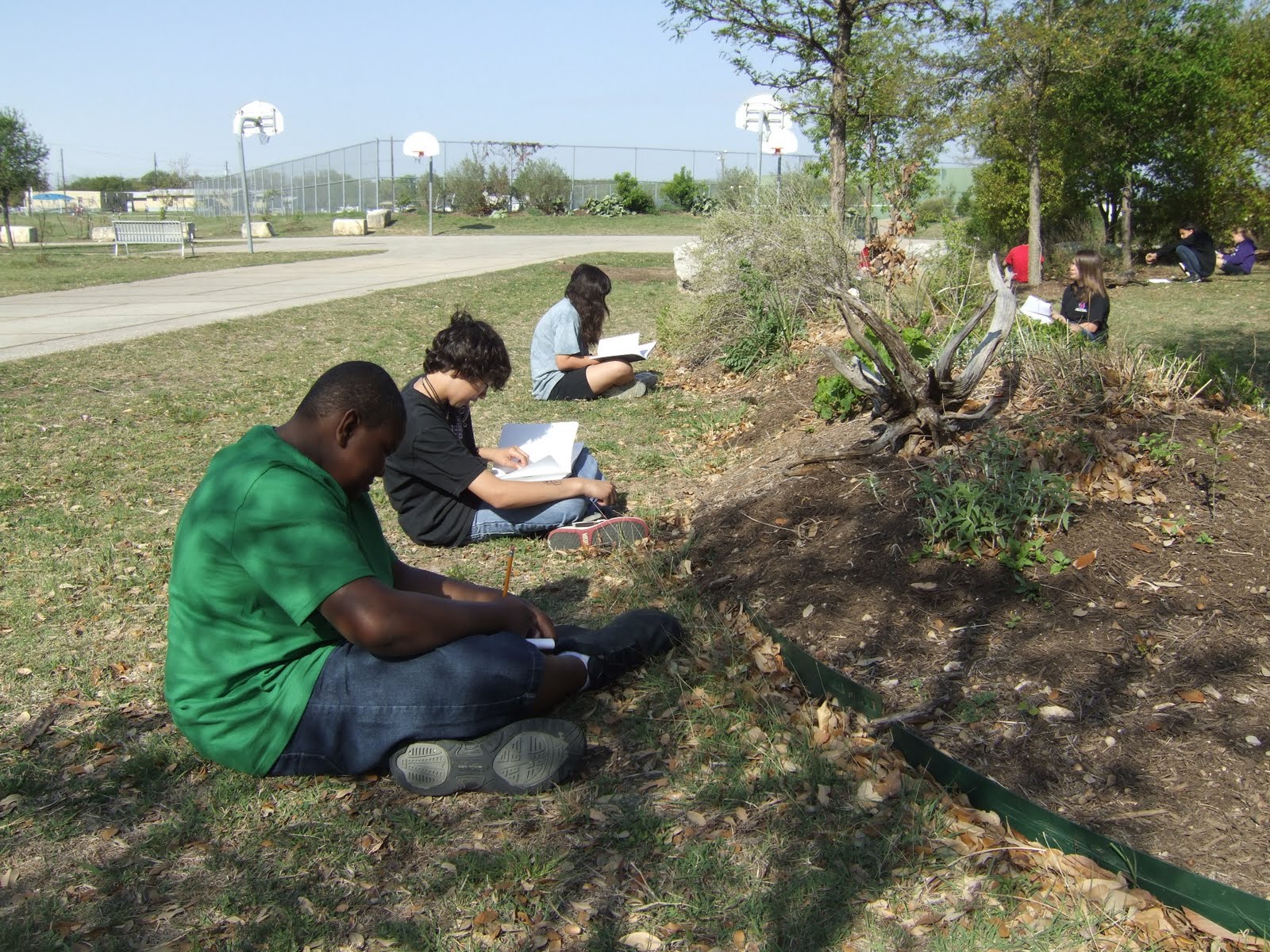
Today was our first attempt at nature journaling.


Students had the following guidelines: Sit on the ground in front of a natural object at least one body length apart from any classmate, Look straight ahead. The area from the ground to the top of your head and from one shoulder to the other is your "view window." Draw a large rectangle on your paper. Inside that box draw what you see. Draw a smaller square. Pick an object from inside your "view window" to draw. Write observations around the boxes. Reserve a corner of your two page spread for questions. Write a few questions.


Written observations focused on color, shape, pattern, size, quantity, texture, fragrance, sound. Animal activity and behavior should be noted.


Students record their observations in their classroom journals which are actually set up as a cross between an field biologist's journal and an interactive one. At the beginning of the semester when we set up the journals, I shared a few articles written by wildlife scientists on the importance of their recorded observations to their research.


I visited each student, making about four circles providing students with feedback and asking questions. Surpringly, I had to give very little redirection.


Observation naturally leads to appreciation. Skills honed outdoors "in the field" transfer back "in the lab." Lessons taught in the classroom are applied and demonstrated outdoors.


Over time students develop their own style. What this student does on paper can be recreated using software like Prezzi. This also aids students in notetaking skills.


The students performed wonderfully. They will share observations, and I'll try to answer some of their questions.

Friday, January 21, 2011

Green Elective Profiles Continued


Courtesy of Chris Brooks:

Introduction to Environmental Studies helps students understand the connections between modern human society and the natural world. Sixth grade student “eco-detectives” investigate the life cycles of the “stuff” we use every day. The first six weeks will focus on the food we eat (where it comes from and what is in it). The second six weeks will look at all the things we use (how they are made and what happens to them after we are finished with them). The third six weeks will focus on eco- projects that allow students to pursue their individual interests (for example, gardening, product design, green building and community service).


Sustainable Food Production and Nutrition Studies is the hands-on gardening and chicken raising class for 7th and 8th graders that helps students understand how food gets from the soil to their plates. Students will follow “permaculture” principles as they prepare soil, manage the water supply, choose appropriate plants, and harvest the crops. Students may also choose to participate in contributing food to our school lunch program and selling their products at the farmers’ market.