August 27 is the first day of school for Austin ISD, Clint Small Middle School, and the Green Tech Academy. While summer was great, and much needed, it is nice to get back into the swing of things on campus. I wanted to use this email to introduce you all to myself and other changes to Small staff, to update everyone on Small events over the summer (pictures to follow), welcome you back, and give a brief overview of basic items needed for the school year, and operations.
Our school had many drastic changes come about at the end of the school year. For most of you that follow this blog, I hope that you are aware that David Matthews, partially retired at the end of the year, going to half time, and is now fully retired. He was our leader, advocate, and inspiration. He is spending time with his family and working on a retirement home on Leakey. His knowledge, expertise and friendship will be greatly missed. Even though he will be around occassionally to help on campus and to offer advice, it won't be the same without him around in the gardens.
We also had many other teachers retire, move campuses, or move on to bigger and brighter things. All of them will be individually missed both personally and professionally. Everywhere I look on campus and at District events it seems there are new faces. I am very excited to welcome everyone and get their fresh perspectives on education and Small!
If you have been at Small at all for the past 4 years, you will be familiar with me. My name is Nate Rosenberg. I have been referenced on this site before working in the greenhouse, running Clean Sweeps, and doing our Earth Day plantings. Chris Brooks and I will be taking over the class load for the Environmental portion of the Green Tech Academy. I have been at Small for 4 years, teaching 6th grade Science and Environmental Sciences. Chris has been teaching for more than a decade, and has been at Small for more that 7 years. Chris has worked in Social Studies, World Cultures, English, and Environmental Sciences. We luckily had a new addition to the Green Tech Academy. Our former Assistant Principal, Sherry Lepine, has added on being our Dean this year. We are super excited! She is already working furiously being an advocate for the program advertising for our GREENFEST, which will be taking place very soon this semester. We will have environmental events, activities, live music from some big Austin acts, food, drink, FUN, education, and mostly FUN. More information will definitely be trickling out when we get it locked in. Each of us will occasionally be contributing to this site and posting pictures of the wonderful things going on at CSMS.
This Summer, Small was crazy busy with events. We had our annual Cougar Camp, where we invited 5th graders on track to attend Small to get to know the campus and our culture. They had a great time! For the first time we offered the STEM Summer Camp. STEM is an acronym for Science, Technology, Engineering, and Math. We did 5 different themed 1 week camps ranging from Endangered Species to Digital Story Telling. Turn out was great and the kids loved it! It was educational and FUN! We didn't lose any kids but some may have had some close encounters and the Austin Nature and Science Center or at Sea World. After the camp, each of us got a chance to work individually, travel, and relax. Chris and I were able to finally finish our chicken coop. We have had chickens and other wildlife in classrooms being taken care of at Small by students for many years. Last year we had some issues will our natural environmental issues colliding with our permaculture. Natural residents on our campus, red-tailed hawks, were struggling last year with the drought and out chickens were an easy entree. Our coop is now hawk and predator proof.
Now for the nitty gritty. For all Environmental Science electives, you will ALWAYS NEED IN CLASS a WRITING UTENSIL, PENCIL OR PEN ONLY, AGENDA, AND A COMPOSITION NOTEBOOK. There is a $5 lab fee. This lab fee will be used to buy new plants, seeds, growing medium, tools, animals holding tanks and many other things. If your family cannot afford the lab fee please email or call me, so alternative arrangements can be made. Right now all supplies are on sale. Please stock up. Almost all classes at Small use the composition notebook, so why not buy a bushel. Classes will be great this year I look forward to seeing and hearing from everyone. As promised photos will follow from this summer.
Showing posts with label David Matthews. Show all posts
Showing posts with label David Matthews. Show all posts
Wednesday, August 22, 2012


Monday, November 28, 2011
Thanksgiving Trees Year Two
With the wind chill near freezing, Native Plants and Animals students planted it forward. They added three trees to our Small Forest. Between the six environmental science classes I teach, we are planting 18 trees on our campus. Last Friday's inch of rain made our task much easier.

Last year Small students planted a dozen trees at Westcave Preserve and thus initiated Thanksgiving Trees, a tradition we hope will adopted by others. The idea is simple. Plant a tree or few around the end of November, reflect on gratitude, and do something positive for the environment.

By 5th period it had warmed up, and we had more trees to plant. This time we added three retamas to the southern end of the Small Forest.


One prominent characteristic of retamas is the long thorns along the trunk and branches. These spikes are perfect for a sated bird to stash a tasty dragonfly for a later meal.
Wednesday, November 9, 2011
One Blustery Fall Wednesday
With temperatures in the 40's and 50's and buffeted by wind gusts up to 30 mph, all of the environmental science classes were out in force today. Mr. Brooks's classes tended to the chickens and vegetables, composted, and worked on their new spiral herb bed. Mr. Rosenberg's classes paced out acres by calibrating their strides around the football field and later tending the front flower beds. My classes worked in the gardens, identified trees using a dichotomous key, and hiked down to Williamson Creek to investigate erosion and collect soil samples.


More photos of winterizing our campus:
Thanks to Keep Austin Beautiful for hooking us up with some quality mulch.

We journaled focusing on the wind and looked for signs of rill erosion.


Students collected two samples from the creek bed and three from the banks. Next week we will test the soils for pH, friability, and ability to clump.

It was a perfect day for a hike. Many students collected broken glass, flood detritus, and other litter.
See more photos:
Photos by Aylin's Eyes and SouperPix Studios
Thursday, March 24, 2011
Nature Journaling: Honing Observation Skills

Observation is a vital skill that is useful in any profession.


Students had the following guidelines: Sit on the ground in front of a natural object at least one body length apart from any classmate, Look straight ahead. The area from the ground to the top of your head and from one shoulder to the other is your "view window." Draw a large rectangle on your paper. Inside that box draw what you see. Draw a smaller square. Pick an object from inside your "view window" to draw. Write observations around the boxes. Reserve a corner of your two page spread for questions. Write a few questions.
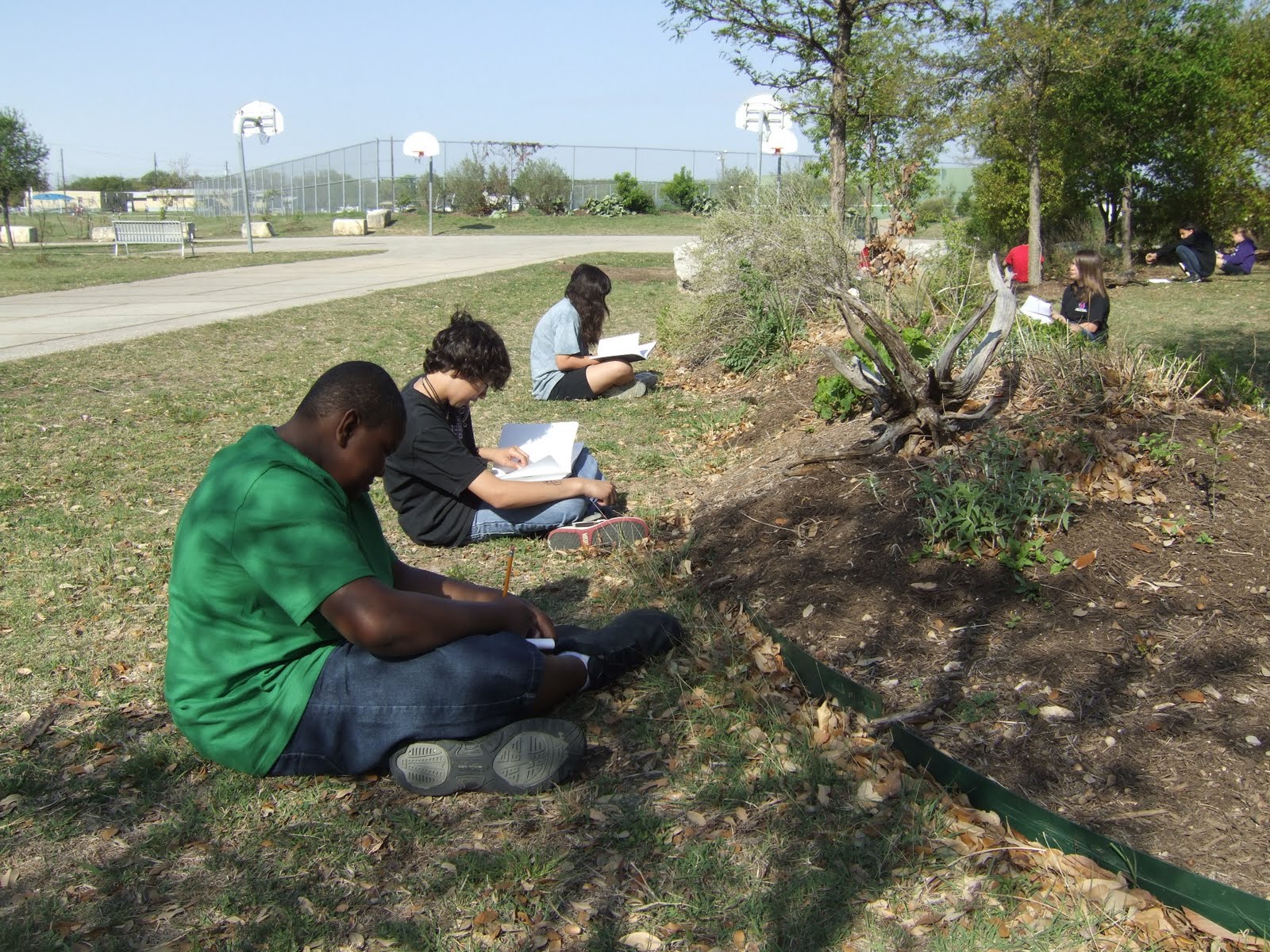
Written observations focused on color, shape, pattern, size, quantity, texture, fragrance, sound. Animal activity and behavior should be noted.

Students record their observations in their classroom journals which are actually set up as a cross between an field biologist's journal and an interactive one. At the beginning of the semester when we set up the journals, I shared a few articles written by wildlife scientists on the importance of their recorded observations to their research.

I visited each student, making about four circles providing students with feedback and asking questions. Surpringly, I had to give very little redirection.

Observation naturally leads to appreciation. Skills honed outdoors "in the field" transfer back "in the lab." Lessons taught in the classroom are applied and demonstrated outdoors.

Over time students develop their own style. What this student does on paper can be recreated using software like Prezzi. This also aids students in notetaking skills.

Friday, February 25, 2011
Bats on Campus & Transplantation Tuesday.
Recognize this little guy?

Bats are occasional visitors on our campus. When Small first opened, the silo stairs were completely enclosed with corrugated steel. No insulation, no windows, very little ventilation.
Temperatures in the silo soared above 100 degrees. Solutuion? Cut large ventilation slits and cover them with wire mesh. This did work. It brought the temperatures down, but the mesh wasn't the proper gauge and bats attempted to colonize it.
Another time, two students found a bat on the ground barely breathing. Naturally, they picked it up bare handed. Animal control promptly incarcerated the bat and sent it off for rabies testing. The students sweated out the results with visions of impending shots. The bat flunked its rabies test. The faculty seized the teachable moment and went over bat safety. Bat Conservation International, headquartered here in Austin, offers a poster for schools regarding this very topic. And speaking of BCI, Kari Gaukler once visited my classes and captivated the students with bat facts and fiction.
Our latest flying mammal visitor suddenly appeared in Ms. Mazac's 3rd floor classroom. This was not the first time she's been visited. Mr. Poliakoff (admittedly this info is at least third-hand) apprehended the cuprit. Next stop for our furry perp, the office. That's when I walked into an excited scene in the front office. Ms. Teinert had the offender under her desk (darkest nearby spot) in order to calm it down. Nice thinking- it worked.

I took it to my advisory class, grabbed the kids and the camera, and proceeded to the Bat Box Hilton, erected near our track as a part of Garrett Dunaway's Eagle Scout project.


After a couple of minutes, our newfound friend flew off.

Transplantation Tuesday

One lucrative trick of the nursery trade is to buy flats (trays) of plant starts in 4" pots and repot them in larger containers. The process is known as "bumping up." All three classes helped.
The previous day, students seeded trays of three tomato varieties, sweet bell peppers, jalepeno peppers and little bluestem grass.
Click on the photo to watch us work:
Friday, January 28, 2011
A Broccolicious Friday in Taste of Science
Another Green Elective Profile
Taste of Science is a one semester class that we offer as part of our Green Tech Academy.
The range of topics include cryptids, ecology, invasive species, pollinators, meteorology, climate change, species reintroduction, and organic gardening. Students will be outside tending to our native and vegetable gardens, journaling, chasing pollinators, hiking, and planting.

We planted this crop from starts last November. We keep our 4x12 beds covered most of the time, but when a stretch of temperate weather is forecast we uncover them. Students have also munched on spinach, cilantro, parsley, and three kinds of lettuce in past veggie breaks this month.

Back to work. One of the first things students study at the beginning of each semester is tool use and safety. We review simple machines. Today we practiced with levers and wedges.


We ended the period visiting the chicken coop. Our 5 hens are laying 4 eggs a day. (Who's the slacker?) Melissa Dunaway, our math lab specialist incorporates our chicken project in her curriculum. Students chart egg weight and length.


Before embarking, a student calls out the data from our nearest Weatherbug station and the class records the data in their field journals.

This trail was recently installed by the Westcreek Neighborhood Association. It is perfect for nature study and is adjacent to our campus.

Pictured above is the Bug Brigade. They are looking for evidence of insects and arachnids.
There were seven other groups: Tree Folks, Critter Club, Bird Brains, Berry Good People, Flower Children, Waterboys, and Weather Watchers.

Bingo! A den.
Looks abandoned, though.

Before heading back we stopped at Williamson Creek. The green metal fence marks the end of the Westcreek neighborhood's greenbelt. Runoff from recent rain has deposited a lot of debris. We plan to return and clean this place up.
Wednesday, November 3, 2010
Dennis Hobbs Individual Achievement Award
Keep Austin Beautiful held its annual awards banquet today.
This is their organizational Silver Anniversary, and the Sheraton ballroom was packed.
At our table were Mayor Pro Tem , Mike Martinez, PODER director and Best Overall winner Susana Almanza, along with my wife, Rita, and principal, Amy Taylor.
Check out the other winners and find out more about the awards here.

This display highlights a lot of our environmental efforts at Small.


Small Middle School principal Amy Taylor and yours truly.

Councilman and Mayor Pro Tem Mike Martinez and unidentified guest.

Me and my students on the big screen.

The award's namesake introducing the awardee.
KXAN weatherman Jim Spencer emceed the ceremony.
I first met Dennis Hobbs on a field trip my classes took to Texas Disposal Systems in the early 90's. As we pulled up to the gate, he boarded our bus. The next hour was like and episode of The Magic School Bus. He proudly showed off the many efforts the landfill was taking to reduce the amount of waste going into the land fill and to reduce the environmental impact of such a large operation.

Glad I took those Speech classes.
It is humbling to receive an award from such a great organization. KAB has worked with my students for the last six years. Their impact on Austin's beauty and environmental ethic is impressive.
Monday, August 30, 2010
Already a Banner Year
School just started last Monday, and by Thursday CSMS had already received two significant recognitions. Through a concerted effort by teachers and students, and with crucial community support last year, our school achieved "Recognized" status from TEA. Perhaps you have noticed the banner on the front fence. Our area superintendent, Bergeron Harris, presented it to us in a faculty meeting.
Hanging proudly next to it is a banner declaring Small Middle School as a founding member of
Hanging proudly next to it is a banner declaring Small Middle School as a founding member of
the Green Ribbon Schools program. To earn this recognition we had to meet four criteria:
1.) have an environmentally friendly campus, 2) offer students nature adventure, 3) provide for our students' health, fitness, and wholesome nutrition (we participate in the CATCH Program), and 4) integrate outdoor education into our curriculum. To learn more about the program follow the link in the section on the right.


I had the best intentions. Really. My classes took two walking tours of the campus during the first week of school. What a great opportunity to take photos of this semester's students checking out our gardens! I was so excited about showing off some of the special secrets hidden on our school grounds. I even had the camera at school. I just never remembered to ask a student to be the photographer.
Pretend you are seeing pictures of the following: We were conducting an informal habitat survey as we walked. The mockingbirds were out and feeding on the American beautyberry. We found several small white eggshell remains under two nesting sites. The Texas ebony, Turk's cap, and esperanza were blooming in the front beds. Honeybees were nectaring.
Students rubbed a leaf of the anacua tree between their fingers. They correctly guessed its common name, sandpaper tree. Two classes saw a tiger swallowtail. Queens and fritillaries were abundant. Students sniffed the leaves from a bay tree and compared it to the smell of Juicy Fruit gum. Our last stop was the toothache tree where students tasted the sweet lemon- minty leaves. Many reported numbness of their lips and tongue (Hence the name- it was a commonly used remedy for Native Americans and early settlers).
I remembered the camera the next day, of course, and had an aide from my first period class go out and take bunch of pictures.


Greeneyes (Berlandiera betonicifolia) and Woolybucket Bumelia
(Bumelia lanuginosa).

Bumble bee (Bombus auricomus, I think) on silver nightshade
(Solanum elaeagnifolium).

Turk's cap (Malaviscus arboreus var. drummondii) and Inland
seaoats (Chasmanthium latifolium).

Fall (dis)obedient plant (Physostegia virginiana) and Inland seaoats


Tropical milkweed (Asclepias curassavica), a non-native.
Yes, I remembered to order the Monarch butterfly tags.
The migration usually comes near the end of October.

Morning glory (Ipomoea lindheimeri)

These guys always run from me. Suha got three pictures of this cute little field mouse (Peromyscus attwateri) before he scampered away.
Subscribe to:
Posts (Atom)